
The Complete Guide to Southern Thai Cuisine
A practical guide to southern Thai cuisine, from its defining ingredients and signature dishes to the markets, kitchens and food traditions that sustain it.
In this guideExplore the cuisine
The Fiercest Kitchen in Thailand
Ask a Thai chef in Bangkok which regional cuisine they respect most and a surprising number will say the south. Not the north, with its herbal delicacy and Burmese borrowings, and not the north-east, with its ferments and grilling. The south. The reason is not that southern food is the spiciest in Thailand, although it is. It is that southern cooking is the most technically demanding, the most aromatic, and the least willing to compromise. It is a cuisine of fresh turmeric, black pepper, shrimp paste and coconut, built by people whose ancestors traded with India and Java and Sri Lanka, and it does not soften itself for anyone.
Within the south, one city sets the standard. Cooks from Nakhon Si Thammarat opened curry stalls across the region and, eventually, across the country, and the version of a dish considered correct in Bangkok is usually the version a Nakhon cook decided on. CNN put it plainly a few years ago: to reach the heart of southern Thai cooking, you go to Nakhon Si Thammarat.
I trained in fine dining and worked in Michelin-starred kitchens before I came home. What brought me back, more than anything else, was the realisation that the food I had grown up eating in a Nakhon Si Thammarat village was more complex than most of what I had been cooking professionally, and that almost no one outside Thailand knew it existed. This guide is an attempt to fix that.
What Makes Southern Thai Food Different
Four things separate southern Thai cooking from the food most visitors know.
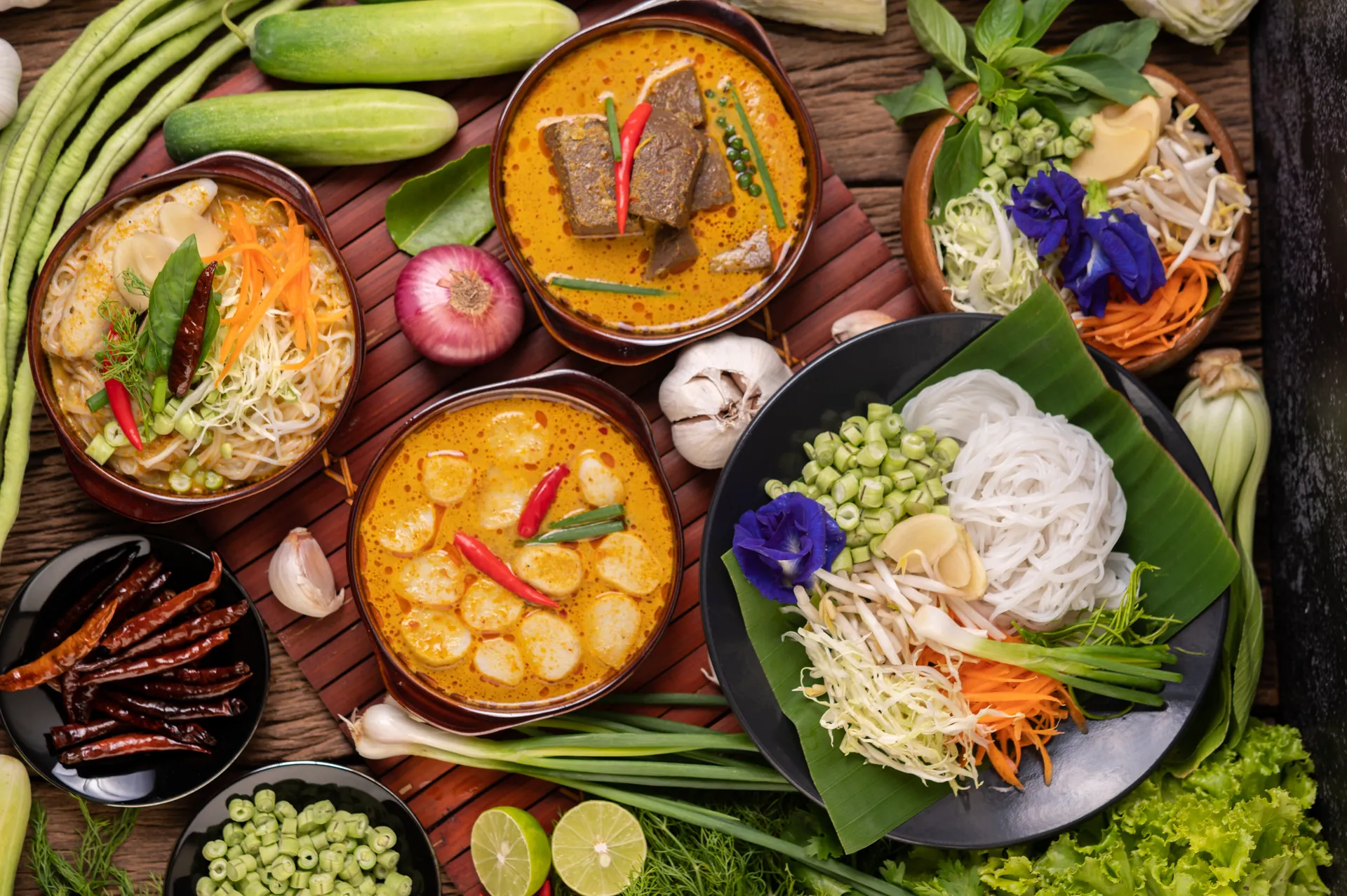
The first is fresh turmeric. Not powder — the root, pounded raw into curry pastes, which gives southern curries their distinctive orange-gold colour, an earthy medicinal bitterness underneath the heat, and a warmth that dried turmeric cannot reproduce. Turmeric arrived from India across the Bay of Bengal and never left. It is in the curry pastes, the fried fish, the rice.
The second is black pepper. Before chillies reached Asia on Portuguese ships in the sixteenth century, heat in Thai food came from pepper, and the south — which grew and traded it — never abandoned the habit. This is why southern heat feels different: it is not the fast bright sting of a fresh chilli but a slower burn that builds at the back of the throat and stays. Most southern curry pastes contain both.
The third is fermented seafood, used with a confidence that other regions do not attempt. Kapi, shrimp paste, is the backbone of nearly everything. Budu, a fermented fish sauce from the far south with Malay origins, is thicker, darker and funkier than standard fish sauce. And tai pla — the salted, fermented stomach of catfish or snakehead — produces the most notorious dish in the Thai repertoire.
The fourth is sourness. The south is a region of citrus, tamarind and a small sour fruit called som khaek, and its sour curries are constructed around acidity in a way that the more famously coconut-rich cooking of central Thailand is not. Gaeng som, the tart turmeric-yellow fish curry, is the perfect expression: sour, salty, hot, with almost no sweetness at all.
One further note on structure. A southern Thai meal is not a sequence of courses but a balance of intensities served at once. A fierce dry curry sits alongside a mild soup, a sour curry, a chilli relish and — always — a large platter of raw and blanched vegetables, herbs and leaves. The vegetables are not garnish. They are the mechanism by which the meal becomes edible, and a southern table without them is incomplete.
The Southern Pantry
Sator, the stink bean
Sator grows in long twisted pods on tall trees and produces flat bright-green beans with a smell that has given it a reputation the taste does not entirely deserve. Sulphurous, yes, and detectable on the breath for a day afterwards, but the flavour is closer to a green almond crossed with a broad bean, with a firm waxy bite. Stir-fried with shrimp paste and prawns — sator pad kapi kung — it is one of the great dishes of the region. The best sator in Thailand is generally agreed to come from Nakhon Si Thammarat, and Bangkok restaurants advertise the provenance.
Kapi and budu
Kapi is made by salting and fermenting tiny shrimp into a dense purple-grey paste, and southern kapi is stronger and less sweet than the central Thai version. It is the foundation of chilli relishes, curry pastes and stir-fries. Budu, produced along the lower gulf coast, is a liquid fermented anchovy sauce boiled with palm sugar and aromatics, and it is the dressing for the rice salads of the deep south.
Coconut
Coconut palms line the coast and the south uses every part of the fruit. The cream enriches curries; the grated flesh is toasted into a nutty topping; the water is drunk; the shell is burned as charcoal. Coconut here is a balancing agent rather than a softening one — it carries fat-soluble aromatics and makes intense curry pastes bloom rather than diluting them.
The leaf platter
The raw vegetables served with a southern meal are worth taking seriously. Cucumber and long beans are the obvious ones, but the platter usually also contains bai liang, the melinjo leaf; cha-om, an intensely aromatic acacia shoot; young cashew leaves; winged beans; and, in season, a handful of things that have no English name at all. Eat them. They cut the heat, reset the palate between mouthfuls and are the reason a meal of this intensity does not become punishing.
The Essential Dishes
Gaeng tai pla
The defining curry of the south and the one that separates the curious from the committed. Tai pla is the stomach and entrails of catfish or snakehead, salted and left to ferment for anything from ten days to a month, then simmered with a turmeric-heavy curry paste, dried fish, bamboo shoots, aubergine and long beans. The result is dark, thick, extraordinarily savoury and extremely hot, with a deep marine funk that has no equivalent in any other Thai dish.
It is often described as an acquired taste. It is more accurate to say that it is a very old one: the dish is recorded in Thai sources back to the reign of Rama II, more than two centuries ago, and its spicing shows clear South Indian influence carried across the Indian Ocean during the centuries of trade with the Tamil kingdoms. It is particularly associated with Phatthalung. If you eat one thing in the south that you cannot get anywhere else, eat this.
Khua kling
The southern dry curry, and the most immediately accessible of the great southern dishes. Minced pork, beef or chicken is stir-fried with a dry curry paste of turmeric, black pepper, chilli and lemongrass until all the moisture has cooked off and the meat is coated rather than sauced. It is finished with shredded kaffir lime leaf. The absence of liquid concentrates everything: this is heat with nowhere to hide, and it is served with a mountain of rice and a platter of raw vegetables for exactly that reason.
Gaeng som and gaeng lueang
Two names for closely related things: a thin, brilliant orange-yellow curry built on turmeric, chilli and tamarind, sour and hot and utterly without coconut. It is almost always made with fish — sea bass, trevally, snakehead — and vegetables that hold their texture, such as green papaya, young taro stems, or the flowering shoots of local greens. In the south it is a daily dish rather than a special one, and a good gaeng som is the truest test of a curry cook in this region. Central Thai versions are sweeter and paler; the southern one is fiercer and considerably better.
Khanom jeen
Fresh fermented rice noodles, served cold in loose nests, over which you ladle a curry sauce of your choosing. This is the signature meal of Nakhon Si Thammarat and the best possible introduction to the region's cooking, because a khanom jeen shop offers four or five sauces at once and lets you compare them in a single sitting.
The standard options are nam ya, a fish-based curry thickened with pounded fish and either coconut milk or none; nam ya pu, made with blue swimmer crab and often served with whole claws; nam prik, a sweeter peanut and coconut sauce; nam ya pa, the jungle version, thin and murderously hot; and in Nakhon Si Thammarat, gaeng tai pla itself is offered as a sauce. Alongside the noodles come pickled vegetables, boiled eggs, fried fish cakes and a further platter of raw leaves. The whole thing costs very little and is eaten for breakfast and lunch.
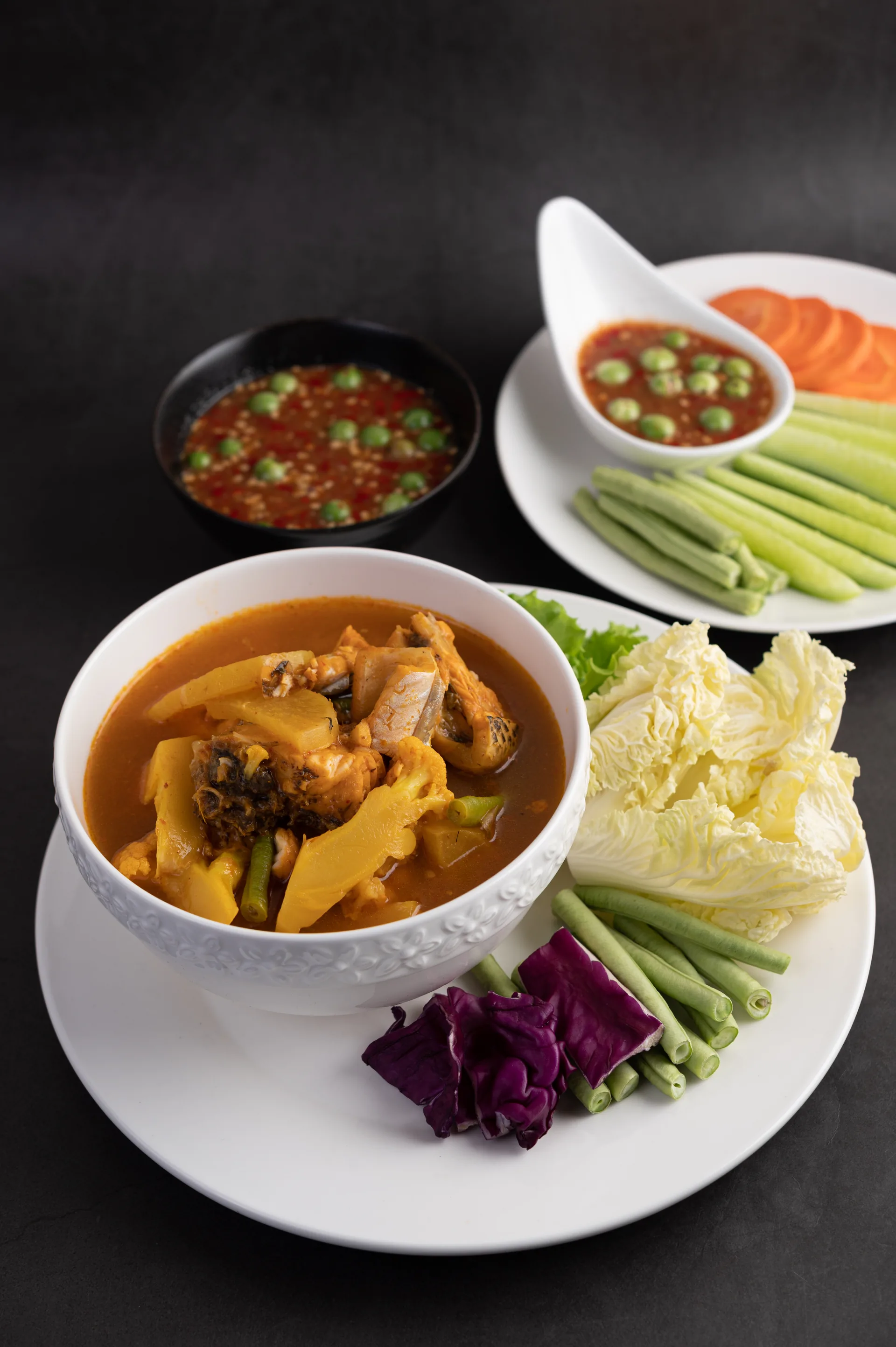 Gaeng som — a bright, sour and spicy fish curry with turmeric, vegetables and fresh greens
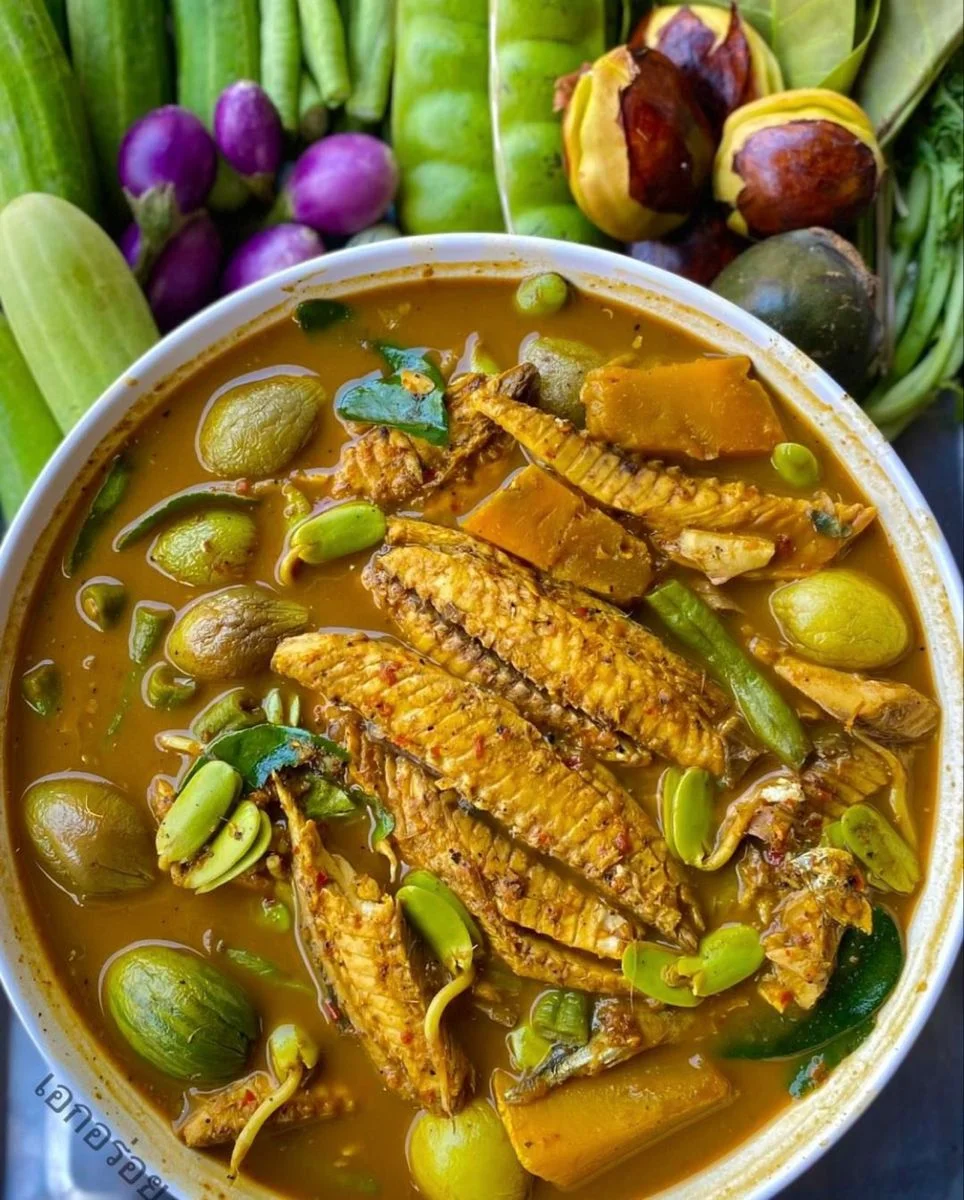 Gaeng tai pla — a pungent fermented-fish curry with herbs, spices and local vegetables
Khao yam
A rice salad, and the gentlest dish in the southern repertoire. Cooked rice — often tinted blue with butterfly pea flower — is tossed at the table with finely shredded lemongrass, kaffir lime leaf, long beans, bean sprouts, toasted grated coconut, dried shrimp powder, pomelo and a dressing of budu. It is fresh, sour, faintly bitter, aromatic and barely spicy at all. It is eaten for breakfast and it is the dish I recommend to travellers who arrive convinced they cannot handle southern food.
Khao mok and the Muslim kitchen
The southern provinces have substantial Thai Muslim communities and a parallel culinary tradition that too many food guides ignore. Khao mok is the Thai biryani: rice cooked with chicken or beef in turmeric, cumin, cardamom and cinnamon, served with a sharp green dipping sauce and a clear soup. Roti, both savoury and sweet, is a street staple. Grilled satay comes with a peanut sauce quite unlike the Bangkok version. In Songkhla and Hat Yai the halal kitchens are among the best places to eat in the region.
Seafood
It would be strange to write about a coastal region without it. What distinguishes southern seafood cooking is the treatment: whole fish deep-fried and buried under a mound of crisp fried garlic and turmeric; squid grilled over coconut charcoal; blue crab steamed and eaten with a chilli-lime sauce; and, on the lagoon, freshwater fish from Songkhla Lake handled with the same care.
Eating Through a Southern Day
The rhythm of eating here is worth understanding, because the best food is frequently served at times visitors are not looking for it.
Breakfast begins early and is savoury. In Nakhon Si Thammarat, the institution is the kopi shop — a Hokkien-descended coffee house serving strong filtered coffee with condensed milk, soft-boiled eggs, and bak kut teh, a peppery pork rib broth that arrives at seven in the morning and is exactly as good as it sounds. Khao man gaeng, rice with a ladle of whatever curry was made that morning, is the other standard. In Hat Yai, breakfast means dim sum, served in bamboo baskets in shops that fill with families from six o'clock.
Lunch is khao gaeng: the rice-and-curry shop, where six to fifteen trays of curries, stir-fries and relishes are laid out behind glass and you point at what you want, taking two or three over rice on a single plate. This is the most efficient way to eat broadly in the south and the single best value in Thai food. Point at the orange one, the dry one and the green vegetable, and you have a complete southern meal for the price of a coffee at home.
Afternoons are for sweets and markets. Khanom la, a lacy fried disc of rice flour folded into a cigar, is a Nakhon Si Thammarat speciality. In Songkhla Old Town, look for ice cream served in a clay pot, charcoal-baked egg cakes, and the taro puddings of Nang Ngam Road.
Dinner is either seafood at a lakeside or beachside restaurant, or a night market. Southern night markets are less about cooked-to-order dishes than about takeaway curries in plastic bags, grilled meats and fruit, and they are where you find the fruit of the region at its best: durian, mangosteen and langsat from the Kiriwong gardens between June and August, and pomelo, rambutan and salak year-round.
How the Three Provinces Differ
Travellers often treat southern Thai food as a single thing. Within these three provinces it is not.
Nakhon Si Thammarat is the classical centre. Its cooks set the reference versions of khua kling, gaeng som and khanom jeen, and the food here is the most intensely flavoured — locals will tell you, unprompted and correctly, that Nakhon dishes have more flavour than the same dishes elsewhere. The city's kopi shop breakfast culture is the strongest in the region.
Phatthalung is agricultural and freshwater. This is the home of gaeng tai pla, and the cooking leans on the lake: freshwater fish, sun-dried and salted catfish, wetland vegetables and the rice grown on the plain between the mountains and the lagoon.
Songkhla is the port, and its food is the most layered. Chinese shophouse cooking sits alongside Thai Muslim halal kitchens and dishes that arrived with European traders, and the old town food streets are the only place in the three provinces where you can eat Hokkien noodles, Malay satay and a southern Thai sour curry within a hundred metres. Hat Yai adds its own signatures: dim sum, and Hat Yai fried chicken, marinated and fried and served under a blizzard of crisp fried shallots.
A Practical Note on Heat
Southern Thai food is genuinely, seriously spicy, and I would rather be honest about it than have you order confidently and suffer.
- Do not ask for "not spicy" and expect it to be mild. In practice a southern kitchen asked for mild will produce something a Bangkok restaurant would consider hot. Ask for phet nit noi — a little spicy — and calibrate from there.
- Eat the vegetables. The raw platter is a functional part of the meal and the fastest way to reset your palate.
- Rice, not water. Water spreads capsaicin around the mouth; plain rice absorbs it. Coconut-based dishes also blunt the heat, which is why a coconut curry is the right thing to order alongside a dry one.
- Build a table, not a dish. Order one fierce dish, one mild, one sour and one soup for a group of four, and the meal balances itself. Ordering three dry curries is a mistake you make only once.
- Start with khao yam or khanom jeen with nam prik. Both are mild, both are excellent, and both give you a foothold in the cuisine before you attempt gaeng tai pla.
Learning to Cook It
Southern Thai cooking is rarely taught to visitors, partly because the region receives few of them and partly because the technique is unglamorous: it is mostly a matter of pounding a curry paste properly in a granite mortar, which takes twenty minutes and cannot be shortcut with a blender without losing the aromatics.
The paste is the whole discipline. Ingredients go into the mortar in order of hardness — dried chilli and salt first, then lemongrass, galangal, turmeric, garlic and shallot, with shrimp paste last — and each is worked to a smooth state before the next is added. A blender chops; a mortar crushes, and crushing ruptures cell walls and releases oils that chopping leaves intact. This is the entire reason a hand-pounded curry smells different, and it is not a romantic claim about tradition. It is mechanics.
The best way to learn is in a village kitchen rather than a cookery school, cooking what the household is cooking that day, from a market shop that morning. That is how we build our culinary journeys, and it is why the recipes travellers take home from us are family recipes with somebody's name attached rather than a standardised curriculum.
Planning notes
Frequently asked questions
What is southern Thai food?
Southern Thai cuisine is the regional cooking of peninsular Thailand, characterised by fresh turmeric, black pepper, fermented shrimp paste, coconut and a pronounced sourness. It is the spiciest of Thailand's four main regional cuisines and shows strong Indian, Malay and Chinese influence from centuries of maritime trade. Signature dishes include gaeng tai pla, khua kling, gaeng som and khanom jeen.
Is southern Thai food the spiciest in Thailand?
Yes. Southern Thai cooking is generally considered the spiciest regional cuisine in Thailand. Its heat comes from both fresh chillies and black pepper, which produces a slower, deeper burn than chilli alone. Mild dishes do exist, notably khao yam rice salad and khanom jeen with peanut sauce.
What is gaeng tai pla?
Gaeng tai pla is a thick, dark, intensely savoury southern Thai curry made from fermented fish stomach, dried fish, turmeric-heavy curry paste, bamboo shoots and aubergine. It is strongly associated with Phatthalung province, has been documented in Thai sources for more than two hundred years, and shows South Indian influence in its spicing. It is the most distinctive dish in the southern repertoire and one of the hottest.
What should I eat first if I cannot handle spicy food?
Start with khao yam, a herb and rice salad dressed with budu that is aromatic rather than hot, or khanom jeen served with nam prik, the sweeter peanut and coconut sauce. Both are authentic southern dishes and neither is punishing. Eat the raw vegetable platter that comes with any southern meal, and use plain rice rather than water to manage heat.
Where is the best place to eat southern Thai food?
Nakhon Si Thammarat. Cooks from this province established the reference versions of most southern dishes and exported them across Thailand, and the khao gaeng curry shops, khanom jeen stalls and kopi shop breakfasts in the city are the most concentrated expression of the cuisine anywhere. Songkhla Old Town offers the most varied eating, with Chinese, Thai Muslim and southern Thai kitchens side by side.
What are stink beans and should I try them?
Sator, or stink beans, are flat green beans from a tall tropical tree, with a sulphurous aroma and a firm, faintly bitter taste closer to a green almond than the smell suggests. Yes, try them, most easily stir-fried with shrimp paste and prawns. The best in Thailand are grown in Nakhon Si Thammarat.
Is southern Thai food available in Bangkok?
Yes, and it has become fashionable there over the past decade, with several well-regarded southern restaurants sourcing ingredients directly from Nakhon Si Thammarat. Bangkok versions are usually toned down in heat and use a narrower range of dishes and vegetables than you will find in the south itself.