
The Complete Guide to Southern Thailand's Culture and Heritage
Explore southern Thailand's living culture and heritage through Nora dance, shadow puppetry, ancient kingdoms, sacred places and regional crafts.
In this guideExplore the heritage
- Heritage That Is Still Being Used
- Tambralinga: The Kingdom Behind the Region
- Wat Phra Mahathat and the Making of Southern Buddhism
- Nora: The Dance UNESCO Recognised
- Nang Talung: Shadow Theatre as Social Commentary
- Songkhla: A Port Town's Layers
- Three Faiths, One Street
- The Crafts
- The Festival Calendar
- Seeing This Properly
Heritage That Is Still Being Used
Most heritage travel in Thailand is archaeological. You walk among the brick foundations of Sukhothai or Ayutthaya, read the interpretive panels, and reconstruct in your imagination a civilisation that ended. It is moving, and it is also fundamentally about absence.
Southern Thailand offers something rarer. Here the heritage is in continuous use. The stupa that anchors the region's Buddhism has been worshipped without interruption for eight centuries and is crowded at six every morning. The dance form that UNESCO recognised in 2021 is performed at village temple fairs by masters who inherited it from their own teachers in an unbroken line. The shadow theatre that satirised local officials in the nineteenth century still satirises them. Nothing here is being reconstructed, because nothing stopped.
That is the argument of this guide, and it is also the reason the international designations have arrived so quickly over the past five years. The bodies that award them are increasingly interested in living traditions rather than preserved ruins, and southern Thailand has more living tradition per square kilometre than almost anywhere else in the country.
Tambralinga: The Kingdom Behind the Region
Before Thailand, before Ayutthaya, before Sukhothai, there was a state on this coast called Tambralinga. It is named in the Pali canon as one of the prosperous port towns of the eastern world, it was ruled independently from the fifth century, and for a period it was joined with Srivijaya, the great Mahayana Buddhist maritime kingdom that dominated the trade routes of Southeast Asia between the eighth and twelfth centuries. Archaeology in Nakhon Si Thammarat has repeatedly confirmed what the texts describe.
Its position explains everything that followed. Ships crossing between India and China had to pass the Malay peninsula or cross it, and Tambralinga sat at a crossing point. Goods moved; so did people, priests, artisans and ideas. Brahmanism arrived from India. Mahayana Buddhism came with Srivijaya. Theravada Buddhism came later from Sri Lanka, and it came here first, before it spread north into the Thai heartland. The architecture and ritual of the region absorbed influences from north-eastern India, central Java, Sri Lanka and the Mon region of southern Myanmar, and it integrated them rather than replacing one with another.
By the thirteenth century the city was the capital of Tambralinga and the principal Buddhist centre of the peninsula. In the traditional Thai administrative order it stood at the head of a system of satellite cities, each associated with an animal of the zodiac — a memory of regional primacy that older residents still refer to. The name the Thais use for the city, Mueang Khon, carries that weight.
This history is not decorative background. It is the direct explanation for why the region's Buddhism looks Sri Lankan, why its curry pastes taste South Indian, why its shadow theatre resembles Javanese wayang, and why a Malay Muslim quarter, a Chinese temple and a first-class royal Thai monastery can all sit within a few kilometres of each other without any of it being remarkable to the people who live there.
Wat Phra Mahathat and the Making of Southern Buddhism
Wat Phra Mahathat Woramahawihan is the principal Buddhist temple of Nakhon Si Thammarat and, by most measures, the most historically important religious site in southern Thailand. At its centre is the Phra Borommathat Chedi, a bell-shaped stupa of roughly seventy-eight metres, built in the early thirteenth century to enshrine relics of the Buddha.
The form matters. The bell-shaped stupa is a Lankan design, and its appearance here is physical evidence of the sea route by which Theravada Buddhism reached the Thai peninsula from Sri Lanka. From Nakhon Si Thammarat that architectural language travelled north and was adopted across the emerging Thai kingdoms. When you look at a Thai chedi anywhere in the country, you are looking at a descendant of this one.
In July 2026 the temple was inscribed on the UNESCO World Heritage List at the 48th session of the World Heritage Committee in Busan, South Korea. UNESCO recognised its outstanding universal value on the grounds of more than fifteen hundred years of sustained religious and cultural tradition, and of the temple's role as a centre from which religious influence, art and architecture spread across maritime Southeast Asia. It is Thailand's ninth World Heritage Site, its sixth cultural property, and the first anywhere in the south.
What the nomination documents emphasise, and what visitors immediately feel, is that this is a living monument. Restoration here has historically been a communal act rather than a state project. Worshippers have donated objects to the stupa for centuries — so many that the temple built a museum to hold them — and the daily practice of circumambulation, offering and merit-making has never been interrupted. The most striking expression of that continuity is Hae Pha Khuen That, the annual ceremony in which the community carries a vast painted cloth through the streets and wraps it around the base of the stupa. It is a collective act of devotion by the whole city, performed at the full moon, and it is one of the great religious spectacles of Thailand.
Nora: The Dance UNESCO Recognised
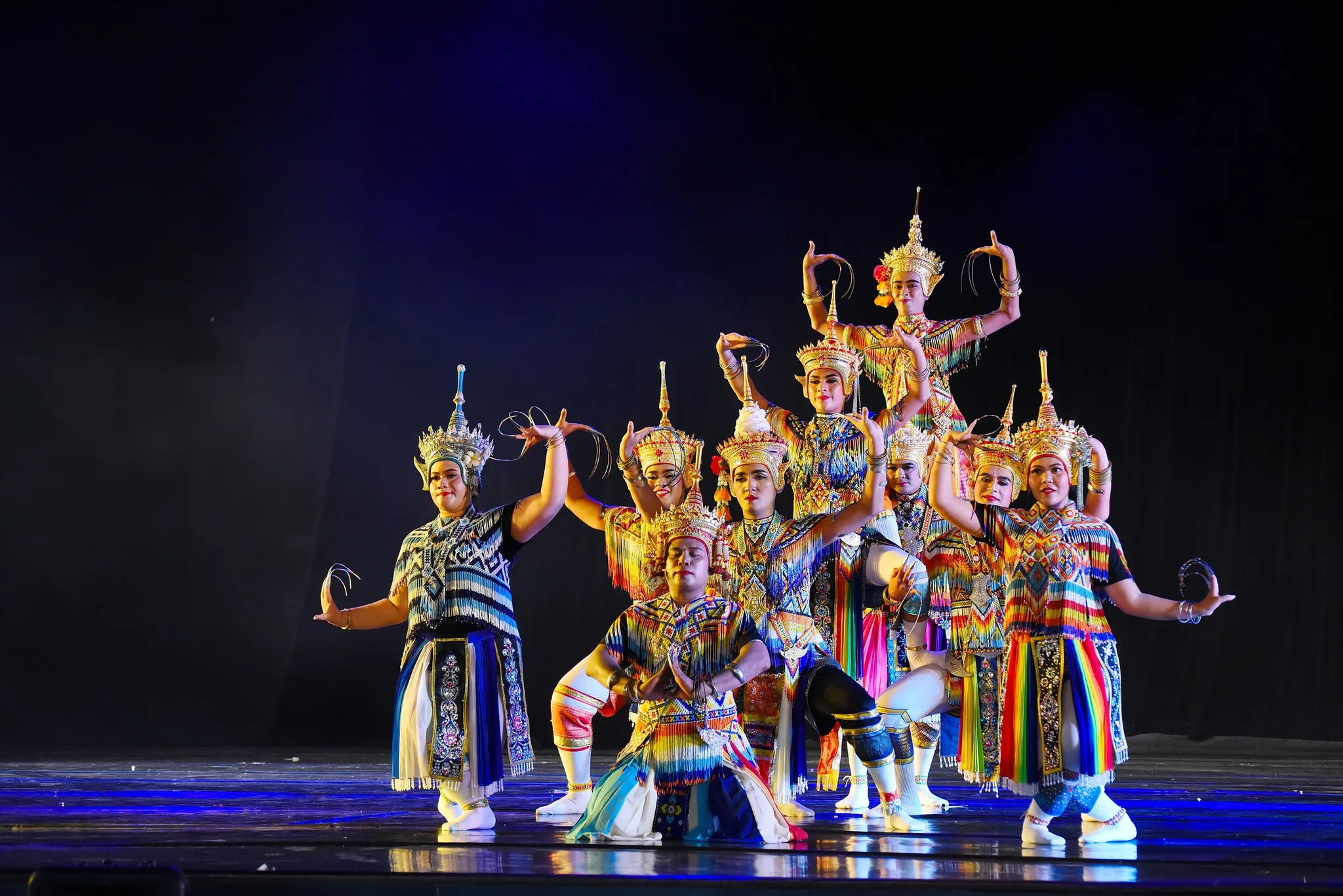
Nora — sometimes written Manora — is the dance-drama of southern Thailand, and in December 2021 it became only the second Thai tradition inscribed on UNESCO's Representative List of the Intangible Cultural Heritage of Humanity, after Khon masked dance.
To watch it is to understand immediately why. Nora is fast, acrobatic and physically extreme. Performances open with a long sung invocation, after which the lead dancer takes the floor with elaborate articulated movements of legs, arms and — above all — fingers, which curl and flare in patterns that take years to master. The costume is unmistakable: a beaded bodice worked in dense geometric colour, wing-like panels tied at the waist, a swan tail behind, a tiered crown or headdress, and long curved metal fingernails extending from the fingertips. The overall effect is deliberately bird-like, and the repertoire's central legend concerns a prince and a half-human, half-bird princess.
The ensemble is loud and driving: a southern oboe carrying the melody over drums, gongs, cymbals and wooden clappers, at a tempo that gives the dancer nowhere to rest. The sung text is improvised in southern dialect, and a skilled Nora master will work the audience, the occasion and the local news into the verses as they go.
Nora is more than five hundred years old, and it is transmitted from master to student in homes and community halls rather than in institutions.
What separates Nora from a folk performance is the ritual dimension. Nora Rong Khru is a multi-day ceremony held to honour the ancestral masters of a Nora lineage, in which the spirits of past teachers are invited to attend, offerings are made, and students are formally crowned and recognised as complete artists. Families with Nora ancestry hold these ceremonies as an obligation to the dead. This is not a performance for an audience; it is a rite performed because it must be, and the fact that outsiders may watch is incidental.
You can see Nora at temple fairs across Nakhon Si Thammarat, Phatthalung and Songkhla, particularly during the festival season, and at cultural institutions such as Thaksin University in Songkhla. What you should be wary of is the polished hotel-lobby version, which strips out the improvisation, the dialect and the ritual and leaves a costume.
Nang Talung: Shadow Theatre as Social Commentary
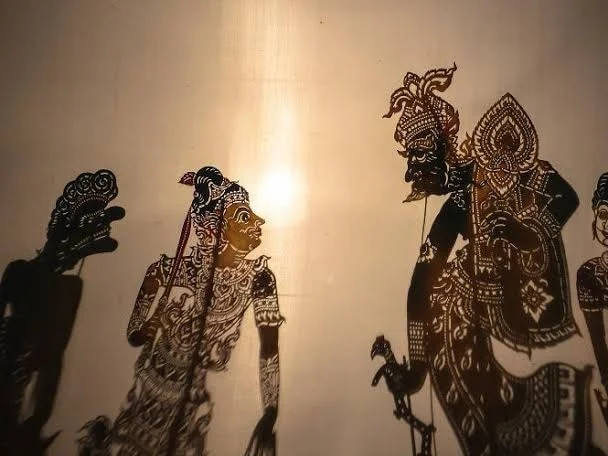
If Nora is the region's sacred art, nang talung is its profane one. Southern Thai shadow puppetry uses figures cut from buffalo hide, tooled and painted and hinged at the arms, typically between fifteen and fifty centimetres tall, worked against a lit white screen. Behind the screen sits a single puppeteer, the nang talung master, who manipulates every figure, voices every character, improvises the entire script and is accompanied by a small band.
The stories draw on the Ramakien and on Buddhist tales, but that is scaffolding. The substance of a nang talung performance is contemporary: the stock comic characters — and every troupe has its own, instantly recognisable to a southern audience — comment on the village, the district officer, the price of rubber, the behaviour of the government and whatever else the master judges worth saying. It has functioned for generations as a chronicle of southern life and as a form of licensed criticism, and it is delivered in dialect, at speed, to an audience sitting on the ground at a temple fair at eleven o'clock at night.
The craft side is equally serious. Cutting a puppet is skilled work: the hide is soaked, scraped, dried, tooled with punches to create the openwork patterns that let light through, then painted and mounted on horn or bamboo rods. A principal character can take days. Several family workshops in Nakhon Si Thammarat still make puppets by hand and are open to visitors; the studio established by the late master Suchart Subsin is the best known and remains a working atelier rather than a display case.
Nang talung is under real pressure. It is technically demanding, the audience for a four-hour late-night performance in dialect is ageing, and preservation campaigns have been running for years. Watching a performance, and paying for it, is not a passive act here.
Songkhla: A Port Town's Layers
Where Nakhon Si Thammarat is a Buddhist capital, Songkhla is a trading port, and its heritage is correspondingly plural.
The old town runs along Nakhon Nok, Nakhon Nai and Nang Ngam roads, and its building stock is Sino-Portuguese shophouse — the architectural signature of the Straits trading world, shared with George Town in Penang and old Phuket — interleaved with traditional Chinese timber buildings, Chinese temples, and a Malay Muslim quarter around the mosque. Hub Ho Hin, a monumental red timber rice mill on Nakhon Nok Road, has been converted into a community heritage museum and is the best surviving industrial building in the quarter.
In 2024, UNESCO added "Songkhla and its Associated Lagoon Settlements" to its World Heritage Tentative List, the formal first stage of nomination. The property is not simply the old town: it comprises four settlement clusters around Songkhla Lake — the ancient towns of Phang Yang, Pha Kho and Si Yang; the historic community of Sathing Phra; the fortified site of Singora at Khao Daeng and Laem Son; and Songkhla Old Town itself. The case Thailand is making is that this constitutes a continuously inhabited lagoon settlement culture, shaped over centuries by maritime trade and by adaptation to a lagoon environment, and that no comparable property exists on the World Heritage List other than Venice.
Across the Tinsulanonda Bridge on the island of Ko Yo sits the Institute for Southern Thai Studies, usually called the Southern Thai Folklore Museum. It is the most important collection of southern Thai material culture anywhere: shadow puppets, Nora costumes and headdresses, textiles, tools, weapons, ceramics and domestic objects, arranged across a hillside complex of pavilions above the lagoon. If you have interest in the subject of this article, this is the single most valuable half-day in the three provinces.
Three Faiths, One Street
The religious composition of these provinces surprises visitors who arrive with an image of Thailand as uniformly Buddhist. The south is majority Theravada Buddhist, with substantial and long-established Thai Muslim communities — particularly in Songkhla and along the lower gulf — and a Chinese population whose temples, clan houses and festivals are woven through the port towns. Brahmanical practice also survives, folded into Thai Buddhist ritual, and Nakhon Si Thammarat retains Hindu shrines that predate the arrival of Theravada Buddhism.
What is striking is how unremarkable the coexistence is locally. A morning market will have halal stalls beside pork vendors; a Chinese shrine and a mosque will be neighbours; a Buddhist temple fair will draw the whole street. This is the direct legacy of the trade history described at the start of this article, and it is one of the most instructive things a visitor can observe here.
Etiquette that matters
- At temples, cover shoulders and knees, remove shoes before entering buildings, and never point your feet toward a Buddha image. At Wat Phra Mahathat, remember it is a place of active worship rather than a monument, and give ceremonies space.
- At mosques, women should cover their hair, and both men and women should dress conservatively. Ask before entering; some are welcoming to visitors and some are not, and the distinction is local rather than doctrinal.
- Never touch a person's head, and never step over someone sitting on the ground — a real consideration at a temple fair where the audience sits.
- Do not touch or photograph a Nora headdress or costume without permission. Both are treated as ritually charged objects, not props.
- Ask before photographing people, especially during ceremonies. It costs nothing and the answer is almost always yes.
The Crafts
Nakhon Si Thammarat has been a royal craft centre for centuries and two of its traditions are nationally famous.
The first is nielloware, known in Thai as kruang thom: silver, engraved with dense patterns and then inlaid with a black metallic alloy that is fused into the engraved lines and polished back, leaving fine silver design against a matt black ground. It is exacting work, historically produced for the court, and Nakhon Si Thammarat is its home in Thailand. Workshops in the city still produce it and the quality range is wide; the good pieces are unmistakable.
The second is yan lipao — basketry woven from the stripped stems of a climbing fern, worked into handbags and boxes so tightly and evenly that the surface looks machine-made. It is among the most prestigious Thai crafts, has long royal patronage, and takes weeks per piece.
Around Songkhla Lake, the crafts are humbler and more useful. On Ko Yo, hand-woven cotton in distinctive stripes is still made on treadle looms in village houses. In the villages around Thale Noi, wetland sedge called krajood is dried and woven into mats, bags and baskets — a craft that has grown into a genuine cottage industry and that supports households directly. Buy from the weaver.
The Festival Calendar
The cultural year in these provinces is dense, and timing a visit around one event transforms it.
- Sart Duan Sip (September or October, tenth lunar month). The great festival of Nakhon Si Thammarat and one of the most distinctive religious observances in Thailand. Families prepare elaborate offerings for ancestors believed to be released from the underworld for a short period, culminating in processions, a huge temple fair and a fairground that takes over the city for around ten days.
- Hae Pha Khuen That (at the full moon; traditionally observed at Makha Bucha and Visakha Bucha). The cloth-wrapping ceremony at Wat Phra Mahathat, in which an immensely long painted cloth is carried through the city and wound around the base of the stupa.
- Chak Phra (October, at the end of Buddhist Lent). Buddha images are pulled through the streets and along the waterways on decorated floats, a tradition particularly strong in the southern provinces.
- Nora Rong Khru (varies; generally in the dry months). Lineage ceremonies held by Nora families. These are not scheduled for visitors and cannot be booked, but a local operator or community contact will know when one is happening.
- Chinese New Year and the Vegetarian Festival (January or February; September or October). Both are observed vigorously in Songkhla and Hat Yai, with processions, opera performances and shrine ceremonies in the old town.
Seeing This Properly
A closing point, and it is the reason this article exists in the form it does. The cultural traditions described here are not performances arranged for visitors. Nora is danced because a family owes a ceremony to its ancestors. Nang talung is staged because a temple is holding a fair. The cloth is carried around the stupa because a city has done it every year for as long as anyone can remember.
That means access is a matter of relationship rather than ticketing, and the difference between watching a genuine ceremony and watching a hotel show is not a matter of taste — it is the difference between seeing the thing and seeing a picture of it. It is also why we build our journeys the way we do, working with families and community organisations who decide what is appropriate to share and when. Where community is the destination, the community sets the terms.
Planning notes
Frequently asked questions
What is Nora dance?
Nora is an acrobatic dance-drama and improvisational singing tradition from southern Thailand, more than five hundred years old, inscribed on UNESCO's Representative List of the Intangible Cultural Heritage of Humanity in 2021. Performers wear beaded costumes with wing-like panels, swan tails and long curved metal fingernails, and dance to a fast ensemble of southern oboe, drums, gongs and clappers. It has both an entertainment form and a ritual form, Nora Rong Khru, held to honour ancestral masters.
What is nang talung?
Nang talung is southern Thai shadow puppet theatre, performed with hinged figures cut from buffalo hide and worked against a lit screen by a single puppeteer who voices all characters and improvises the dialogue in southern dialect. Its stories draw on the Ramakien and Buddhist tales, but performances are largely contemporary social and political commentary. It is traditionally staged at temple fairs, late at night.
Where can I see Nora and shadow puppetry in southern Thailand?
At temple fairs and festivals across Nakhon Si Thammarat, Phatthalung and Songkhla, particularly during the festival season. Shadow puppet workshops in Nakhon Si Thammarat, including the studio founded by the late master Suchart Subsin, demonstrate puppet-making and performance. The Institute for Southern Thai Studies on Ko Yo, Songkhla, holds the most important museum collection of both traditions.
What was Tambralinga?
Tambralinga was an early maritime state centred on what is now Nakhon Si Thammarat, ruled independently from the fifth century CE and named in the Pali Buddhist canon as a prosperous port town. It was at times joined with the Srivijaya empire and became a major Theravada Buddhist centre by the thirteenth century. It is the historical foundation of the culture of the three southern provinces.
Why is Wat Phra Mahathat important?
It is the principal Buddhist temple of Nakhon Si Thammarat and the most historically significant religious site in southern Thailand. Its bell-shaped stupa, built in the early thirteenth century, follows Sri Lankan design and marks the sea route by which Theravada Buddhism reached the Thai peninsula. The architectural form spread from here across Thailand and Southeast Asia. The temple was inscribed on the UNESCO World Heritage List in July 2026 — the first World Heritage Site in southern Thailand.
Is southern Thailand Muslim or Buddhist?
Nakhon Si Thammarat, Phatthalung and Songkhla are majority Theravada Buddhist, with long-established Thai Muslim communities, particularly in Songkhla, and a significant Chinese population with its own temples and festivals. The three traditions coexist visibly and unremarkably in daily life. The Muslim-majority provinces of Thailand are further south, in Pattani, Yala and Narathiwat.
What crafts is Nakhon Si Thammarat famous for?
Two in particular: nielloware, or kruang thom, in which engraved silver is inlaid with a black alloy and polished, historically produced for the Thai court; and yan lipao, basketry woven from the stems of a climbing fern into extremely fine handbags and boxes. The province is also the centre of shadow puppet making.